it seems that I've had about thirty conversations in the last month about shilo's hearing, and our choice to not use hearing aids (for now), as well as using ASL as her first language. some of the conversation has been because we had another sedated abr, and there was a new audiologist who delivered the results. some was a result of going to a conference for parents of children who are deaf or hard of hearing. and, some are because shilo will be three in a few weeks, so she ages out of early intervention and into the school system.
so here's some more information for those who are interested. first of all, there is a whole community that some know exist, and some don't. it's the deaf community. in this community, being deaf or hard of hearing is not seen as something that needs fixed. the adults in this community are just like the adults in any other community. some went to college. most of them have jobs. they raise their children, go to soccer games, and have hobbies. they might use apps on their phones to help make doctors appointments or to help with ordering in a restaurant. but, they are perfectly capable of functioning in the world, just like everyone else. some of them choose to use hearing aids for themselves or children. some don't.
most hearing parents who find out that their child is deaf or hard of hearing choose to use hearing aids, have cochlear implants, and to work hard to make certain their child speaks. the view is often that being deaf or hard or hearing is something that needs fixed. for people who are hearing, it's hard to imagine functioning in a world where hearing, and speaking are the norm, and not having those things.
our personal view lines up more with the deaf community. while shilo has some hearing, and we have hearing aids for her, she doesn't like to wear them. matter of fact, without them on, if their is a loud noise, she puts both of her hands on her head and makes a whiny noise, or sometimes cries. she is completely overwhelmed by loud noises. hearing aids just amplify this. so for her, her hearing aids cause her to feel overwhelmed. she stops playing or interacting. most of the professionals we have worked with have pushed us to have her wear them as much as possible so she will get used to them. we have followed her lead and decided that if they are overwhelming for her, we aren't using them for now. some day, she might change her mind.
also, while this isn't always true, because people with Down syndrome are individuals, and there is no one thing that describes everyone with Ds, often times, people with Ds can be hard to understand. they have low muscle tone, and it's harder for them to move their mouth and tongue in the ways needed. people who are deaf or hard of hearing also, often times, have trouble with speech because they don't hear certain sounds. for us, this meant that it was possible that shilo would have extremely hard to understand speech as a result of her Down syndrome and being hard of hearing. our goal for her was communication. we wanted her to be able to communicate her wants and needs easily. so it made sense to us to have ASL be her first language.
at this point, we are not working on speech with her. I don't foresee it being something we do in the future, either. we still talk to her while we are signing. she still hears music, and watches signing time that is both signing, speaking, and music. we are not preventing her from learning oral language. however, we are also not willing to spend hours of therapy every week trying to make her imitate sounds. i'd much rather we use that time for motor skills.
so at this point, shilo's communication is almost all through ASL. (she verbally says, mama, papa, go, and Abigail sometimes. however, she signs those things more often than saying them). she actually has a vocabulary on par with that of other three year olds, and uses two and three word sentences. she uses feeling words, and blows us away all the time by signing something we had no idea she knew. just like all toddlers, she has some words that are the same, and we have to figure out in context what she is saying.
we know that everyone makes the choice for their child that they think is best. I am not saying that people who choose to use hearing aids, implants, and/or oral language are wrong. but, for whatever reason, every conversation we have about hearing, language, and the choices we have made based on what we are doing for Shilo, I have to defend it.
here's our defense: we love our daughter. we are the ones who spend more time with her than anyone else out there. we know her. we have tried to do what is best based on what we have observed from her. it's working for her, and our family. i'm going to assume that the majority of people I meet are doing the same, whether it has to do with hearing, schooling, or the millions of other things, we, as parents, have to make decisions about. if you could make the same assumption about us, we would appreciate it.
Showing posts with label cochlear implant. Show all posts
Showing posts with label cochlear implant. Show all posts
Thursday, October 23, 2014


Friday, January 11, 2013
understanding hearing loss.
it's pretty unusual for a child who breaks their leg to need it amputated, although not completely out of the realm of possiblity. and if a doctor suggested this as the first option you would likely want a second opinion. i'm going to compare this to my youngest daughter being deaf. whenever someone inquires about her hearing aid, or finds out she's deaf, i immediately get a 'oh, are you going to do cochlear implants?' of 'you should get those implant things so she can hear. have you ever seen those youtube videos where a child hears for the first time? it's just amazing!'
i don't expect the general population to have information on hearing loss and how it's treated. i only knew basics before shilo came along. so i'm going to try to explain why cochlear implants do not work for everyone, and why shilo has a baha.
first of all there are tons of little components that make up your inner ear, and aid in hearing. you have an ear drum, some tiny bones, air and space, and a cochlea. the first few things take the noise in and send it to the cochlea, which is hooked to a nerve. that nerve sends the signal to your brain to tell you what you are hearing. if any of these things isn't developed correctly, or does not work, your hearing is affected. even an ear infection causing fluid to build up behind the ear drum can cause temporary hearing loss.
there are three different types of hearing loss:
conductive hearing loss: Conductive hearing loss occurs when sound is not conducted efficiently through the outer earcanal to the eardrum and the tiny bones (ossicles) of the middle ear. Conductive hearing loss usually involves a reduction in sound level or the ability to hear faint sounds. This type of hearing loss can often be corrected medically or surgically.
sensioneural hearing loss: Sensorineural hearing loss (SNHL) occurs when there is damage to the inner ear (cochlea), or to the nerve pathways from the inner ear to the brain. Most of the time, SNHL cannot be medically or surgically corrected. This is the most common type of permanent hearing loss.
mixed hearing loss: Sometimes a conductive hearing loss occurs in combination with a sensorineural hearing loss(SNHL). In other words, there may be damage in the outer or middle ear and in the inner ear(cochlea) or auditory nerve. When this occurs, the hearing loss is referred to as a mixed hearing loss.
all these definitions were taken from this website.
and now the basics of a cochlear implant. a c.i. actually takes the place of your cochlea. in essence the doctor goes in and kills the cochlea to implant an artificial one. so like a prosthetic limb that an amputee might wear.
so someone with a conductive hearing loss doesn't need a cochlear implant. there's no reason to kill their cochlea since it is working just fine. someone with sensioneural hearing loss could benefit from a cochlear implant. and someone with mixed may or may not benefit from an implant.
shilo has mixed hearing loss. both of her cochleas work perfectly fine. she has either tissue or fluid in the inner ear where there should be space. and her snhl is past the cochlea and on her auditory nerves. so killing her cochlea would be like amputating a leg that would work just fine with a few pins to help the bones do what they should.
shilo uses (and i say that term loosely, because she's not a very big fan of wearing her hearing aid at the time) what is called a bone anchored hearing aid, on a soft band. (they don't actually implant the anchors until children are at least five. fda regulations). so what her hearing aid does is bypass the outer ear, and send the sound through her skull bone directly to her cochlea. even a hearing person and put this on their head and 'hear' through it. it's a pretty spectacular piece of equipment. we have a friend, baby aria, who uses a baha as well. her hearing level is normal with it. shilo's hearing levels will never be normal because of the damage to the auditory nerves. so even with the baha on she is still only hearing at a moderate level.
so the next time you talk to someone, and find out their child is deaf or hearing impaired, please don't encourage them to have an immediate amputation. parents are being bombarded by so many different types of hearing aids, as well as trying to decide whether they want to use sign or an oral method (or both). they have lots of different professionals telling them different things already. i personally, am not even a fan of the 'i'm so sorry.' we aren't that sad about her being deaf. she's an awesome little girl. she can feel music. she LOVES signing. LOVES it. she has multiple words she signs regularly (mama was her first). she understands so much more than she can sign back to us. a hearing person feels like being deaf means you are missing out. since she's never been able to hear, she isn't missing anything. her world is what it always has been. and we accept her just exactly the way she is.
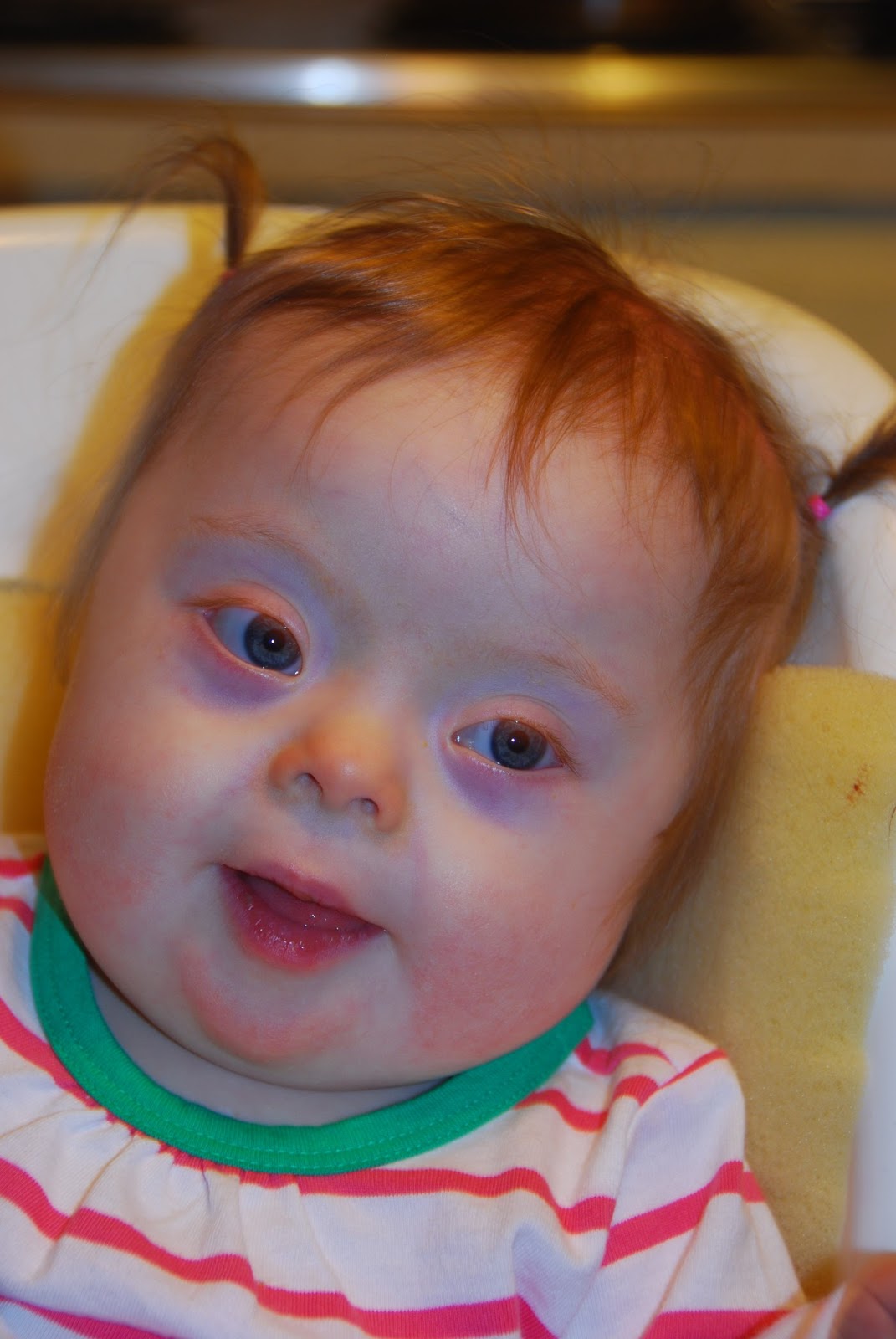 |
| why would we want to change her? |
Subscribe to:
Posts (Atom)